


Your Integration & Report Co-Pilot

Your AI Co-Pilot for Building
Reports & Integrations 80% Faster.

Opkey's TechAgent automates the repetitive 70% — report generation, integration templates, API configurations — so experts can focus on the most critical 30%.

70%

Grunt work handled by AI

10X

Faster time-to-deliverable

30%

Where your experts add value

Trusted by 300+ enterprises worldwide

The Problem

Technical Objects Consume Up to 30% of Your ERP Timeline & Budget And Are a Leading Cause of Delays & Cost Overruns.

Custom Reports, Integrations, and Data Loaders are the invisible backbone of every ERP rollout. Yet most of the effort is spent on repetitive boilerplate — not business logic.

40–60%

of implementation budget burned on repetitive technical build work

200–500

custom reports, integrations & data loads per enterprise rollout

2–6 wks

per deliverable — most of it boilerplate your team has built before

30–40%

defect rate from hand-coding the same patterns over and over
How It Works

Describe What You Need. The Agent Drafts It. Your Team Finalizes It.

From HR, Finance and Supply Chain transformations to ongoing change — Opkey's AI Agents automate 90% of the manual work across your application lifecycle. From configurations to testing to training, all automated — making Opkey not only the leading enterprise testing tool but a complete lifecycle solution for modern cloud applications.

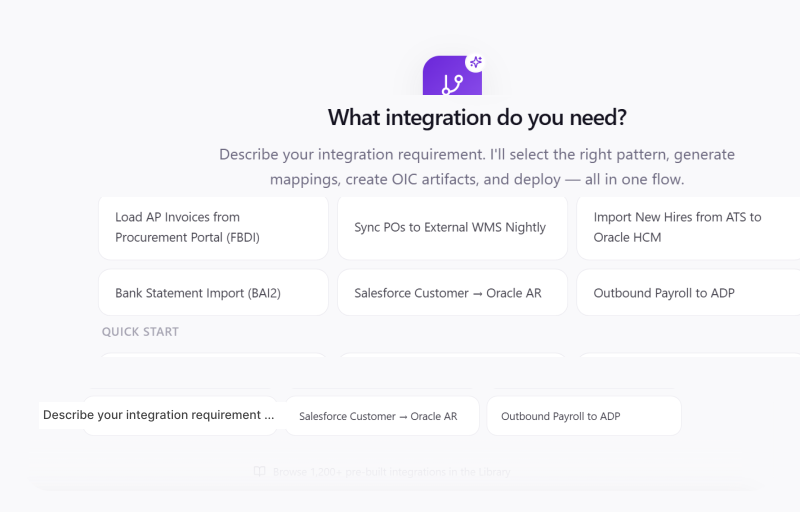
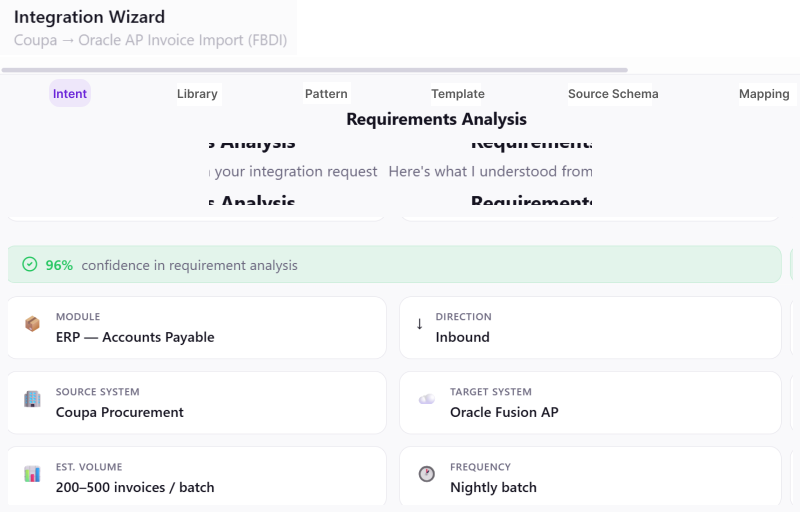
Your Team Describes the Requirement

A consultant types: 'We need a weekly AP aging report by business unit with 30/60/90 day buckets.' The agent extracts the report type, data source, grouping, parameters, and delivery schedule — then asks clarifying questions if anything is ambiguous.

Accordion image

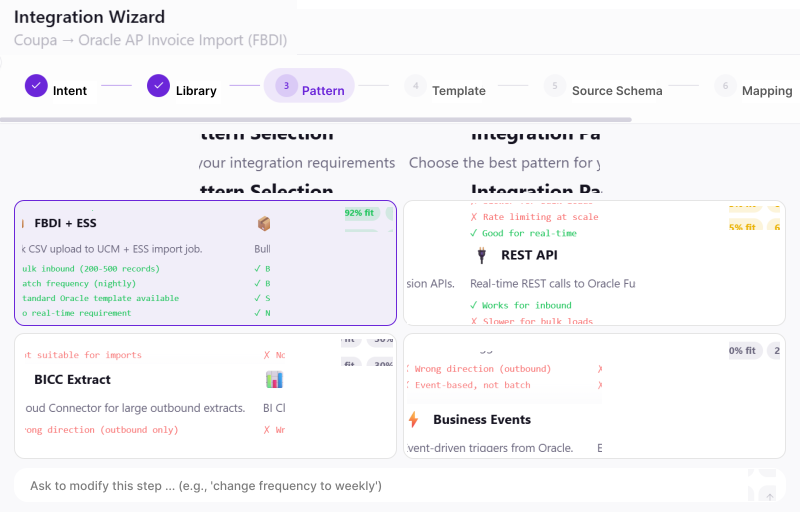
Agent Picks the Right Pattern for Your Platform

For Oracle Cloud: FBDI bulk imports, REST APIs, BI Publisher reports, scheduled processes. For Workday: EIBs, Studio integrations, Custom Reports, Calculated Fields, Cloud Connect. The agent doesn't confuse Oracle patterns with Workday patterns.

Accordion image

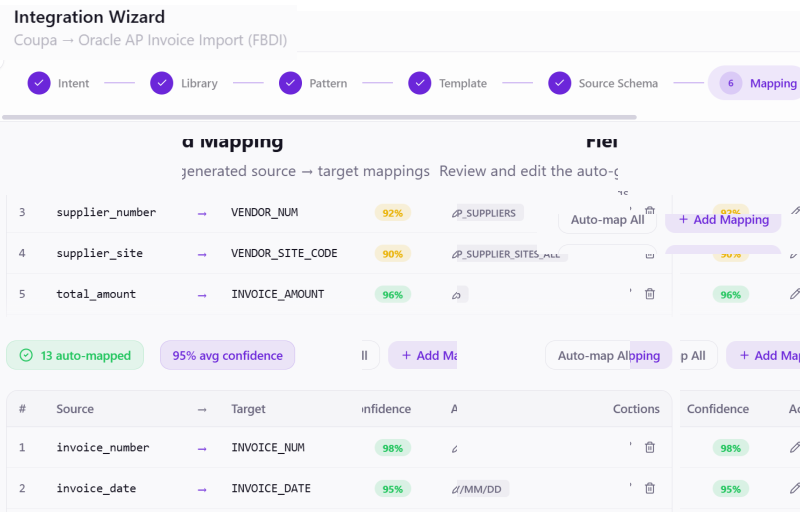
Knowledge Graph — Exact Specs, Not Guesses

The Knowledge Graph contains exact data template column specs, REST API schemas, job definitions, and security role mappings for each platform. The agent doesn't hallucinate field names or guess at API parameters — it looks them up.

Accordion image

Cross-Module? Agent Coordinates, Team Validates

For a Procure-to-Pay flow: the agent generates the supply chain piece (PO extraction) and the finance piece (invoice matching) separately, then produces a coordination spec. Your integration architect reviews the sequencing and business rules.

Accordion image

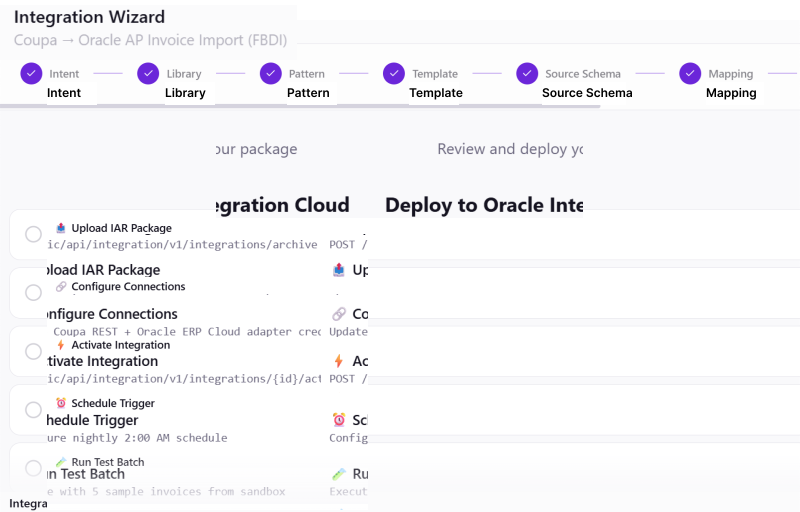
API-First Deployment — No RPA Fragility

Integrations deployed via REST API. Connections tested programmatically. Jobs submitted with monitoring. Your team reviews in sandbox before promoting to production — with full documentation already generated.


Accordion image

Plan with Confidence
Your Team Describes the Requirement

A consultant types: 'We need a weekly AP aging report by business unit with 30/60/90 day buckets.' The agent extracts the report type, data source, grouping, parameters, and delivery schedule — then asks clarifying questions if anything is ambiguous.

Agent Picks the Right Pattern for Your Platform

For Oracle Cloud: FBDI bulk imports, REST APIs, BI Publisher reports, scheduled processes. For Workday: EIBs, Studio integrations, Custom Reports, Calculated Fields, Cloud Connect. The agent doesn't confuse Oracle patterns with Workday patterns.

Knowledge Graph — Exact Specs, Not Guesses

The Knowledge Graph contains exact data template column specs, REST API schemas, job definitions, and security role mappings for each platform. The agent doesn't hallucinate field names or guess at API parameters — it looks them up.

Cross-Module? Agent Coordinates, Team Validates

For a Procure-to-Pay flow: the agent generates the supply chain piece (PO extraction) and the finance piece (invoice matching) separately, then produces a coordination spec. Your integration architect reviews the sequencing and business rules.

API-First Deployment — No RPA Fragility

Integrations deployed via REST API. Connections tested programmatically. Jobs submitted with monitoring. Your team reviews in sandbox before promoting to production — with full documentation already generated.

Plan with Confidence

A consultant types: 'We need a weekly AP aging report by business unit with 30/60/90 day buckets.' The agent extracts the report type, data source, grouping, parameters, and delivery schedule — then asks clarifying questions if anything is ambiguous.

For Oracle Cloud: FBDI bulk imports, REST APIs, BI Publisher reports, scheduled processes. For Workday: EIBs, Studio integrations, Custom Reports, Calculated Fields, Cloud Connect. The agent doesn't confuse Oracle patterns with Workday patterns.

The Knowledge Graph contains exact data template column specs, REST API schemas, job definitions, and security role mappings for each platform. The agent doesn't hallucinate field names or guess at API parameters — it looks them up.

For a Procure-to-Pay flow: the agent generates the supply chain piece (PO extraction) and the finance piece (invoice matching) separately, then produces a coordination spec. Your integration architect reviews the sequencing and business rules.

Integrations deployed via REST API. Connections tested programmatically. Jobs submitted with monitoring. Your team reviews in sandbox before promoting to production — with full documentation already generated.

Accordion image
RESULTS FROM EARLY ADOPTERS

70%

Repetitive work eliminated

10x

Faster time-to-deliverable

3x

More deliverables per sprint

300+

Enterprise deployments
Customer Story
"We had 200+ integrations to build. The Tech Agent generated the scaffolding and transformation logic — our team just validated the business rules and deployed. Months of work done in weeks."
200+
Integrations delivered
70%
Agent-generated code
3x
Faster than manual
VP of Enterprise Applications
Fortune 500 Consumer Goods
Customer Story
"Our consultants used to spend 4 weeks per
interface on boilerplate. Now the agent drafts it
in hours and they spend their time on the business
logic that actually matters."
70%
Less boilerplate work
4 wks -> 1
Per deliverable
Zero
Agent-caused defects
Director of Integration Architecture
Global Retail Enterprise
Customer Story
"The agent knows Oracle FBDI patterns and Workday EIB patterns separately. It doesn't confuse them. Our team reviews and ships — that's the right division of labor."
100%
Pattern accuracy
2
Platforms supported
50+
Object types covered
Sr. Integration Architect
Fortune 500 Healthcare
Platform Coverage

Built for Oracle Cloud Today. Workday Coming Q2 2026.

The agent knows each platform's native mechanisms — so the artifacts it generates are always platform-correct and ready for your team to validate.
Oracle Cloud
AVAILABLE NOW
Finance
Supply Chain
Human Resources
FBDI Bulk Import
Agent generates templates, transformation scripts & job configs
REST APIs
Agent generates API configs, authentication setup & payload mappings
BI Publisher Reports
Agent generates data models, layouts & scheduling definitions
Scheduled Processes
Agent generates job definitions, parameter configs & monitoring rules
Workday
COMING Q2 2026
HCM
Financial Management
Payroll
EIBs (Enterprise Interface Builder)
Agent will generate EIB configurations, field mappings & transformation logic
Studio Integrations
Agent will generate Studio integration flows, XSLT transforms & connector configs
Custom Reports & Calculated Fields
Agent will generate report definitions, data sources & calculated field formulas
Cloud Connect & Extend Apps
Agent will generate connector configurations and Extend app scaffolding
FAQ

Common Questions from
Integration Teams

What the 70/30 split looks like in practice, which platforms are supported, how the agent avoids hallucination, and how your team stays in control.

Still have questions?

Our team is happy to help you get started.

Talk to an expert ->

For every report, integration, data load, or extension your team builds, roughly 70% of the work is repetitive scaffolding — writing transformation scripts, configuring data templates, setting up error handlers, assigning security roles. The Tech Agent generates all of that. Your consultants then focus on the remaining 30%: validating business rules, testing edge cases, getting stakeholder sign-off, and deploying to production.

No. It's a co-pilot, not a replacement. Your integration architects and developers still own the business logic, validate every generated artifact, and make the final deployment decision. The agent eliminates the repetitive coding so your team can deliver 3x more per sprint — or finish projects in a fraction of the time.

Oracle Cloud is available now — covering Finance (FBDI, REST APIs, BI Publisher), Supply Chain (EDI, event-driven, bulk import), and HR (file-based imports, data extracts). Workday support is coming Q2 2026, covering EIBs (Enterprise Interface Builder), Studio integrations, Custom Reports, Calculated Fields, Cloud Connect, and Extend apps.

The agent uses separate specialist modules for each platform. For Oracle Cloud, it knows FBDI template structures, REST API schemas, BI Publisher data models, and scheduled process configs. For Workday, it knows EIB configurations, Studio integration flows, XSLT transforms, and connector setups. These are never cross-contaminated — an Oracle FBDI pattern will never be suggested for a Workday integration.

The Knowledge Graph is a deterministic database of exact technical specifications — API endpoints, data template column definitions, job parameters, security role mappings, and validation rules for every supported business object. Unlike general-purpose AI that 'guesses' field names or API structures, the Tech Agent looks them up. This eliminates hallucination and ensures every generated artifact is technically accurate.

Yes. The Master Orchestrator detects cross-module requirements and decomposes them into module-specific sub-tasks. For Procure-to-Pay, it generates the supply chain piece (PO extraction) and the finance piece (invoice matching) separately, then produces a coordination spec. Your integration architect reviews the sequencing and business rules before deployment.

The agent delivers a complete package: transformation scripts, data mappings, API configs, error handlers, security assignments, and full technical documentation. Your team reviews each artifact against business requirements, adjusts any org-specific logic, runs UAT, and deploys through your standard change management process. The agent also generates the documentation your team would normally write manually.

Low-code platforms still require you to know which API to call, which data template to use, and which security roles to assign. You're still doing the work — just with a visual interface. The Tech Agent encapsulates platform-specific domain knowledge and generates the artifacts directly from a business-level description. Your team reviews and deploys instead of building from scratch.

Most teams are running their first agent-assisted deliverables within days. The platform connects to your ERP environment via standard authentication and requires no custom infrastructure. Your existing consultants and developers continue using their normal tools — the agent simply pre-generates the artifacts they would have hand-coded.

Go Live On Time. Update With Confidence.

Accelerate 90% of cloud app configuration, testing and training with the only test automation platform built for enterprise success.

Join 300+ enterprises using Opkey to accelerate go-live by 30% and reduce update risk by 80%.

© 2026 Opkey. All rights reserved.
×